

Monday, March 14, 2022

Tuesday, March 1, 2022
As Bears or Wild Bulls

The barbarities and desperate outrages of the so-called Christian race, throughout every region of the world, and upon every people they have been able to subdue, are not to be paralleled by those of any other race, however fierce, however untaught, and however reckless of mercy and of shame, in any age of the earth.William Howitt, Colonization and Christianity - a popular history of the treatment of the natives by the Europeans in all their colonies - 1838

Swept under the rug, the story of the Swedish Empire's part in the European conquest of the New World.

Like LaSalle they landed on the Gulf Coast of present day Texas, pushed west into the gold and cannabis fields of California and, in a final berserking rampage, made quick work of the Aztec and Mayan Empires leaving little for Cortez to do.

Odin’s men rushed forwards without armor,
were as mad as dogs or wolves, bit their shields, and were strong
as bears or wild bulls, and killed people at a blow, but neither
fire nor iron told upon themselves. These were called Berserker.
were as mad as dogs or wolves, bit their shields, and were strong
as bears or wild bulls, and killed people at a blow, but neither
fire nor iron told upon themselves. These were called Berserker.
Ynglinga Saga 6
Sunday, January 23, 2022
Friday, January 21, 2022
Wednesday, December 22, 2021
Strictly Platonic Game Night
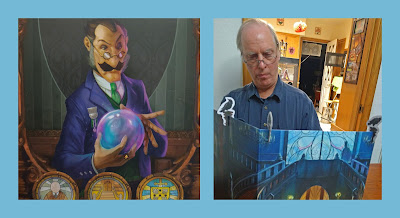
The Superstition that preceded wisdom

Searching for Truth

Philosophy meets Rock & Roll

Let a hundred schools of thought contend, well, a half dozen anyway

Plato, meet Elvis

And the winner is Plato. No surprise there.
"The inexperienced in wisdom and virtue, ever occupied with feasting and such, are carried downward, and there, as is fitting, they wander their whole life long, neither ever looking upward to the truth above them nor rising toward it, nor tasting pure and lasting pleasures. Like cattle, always looking downward with their heads bent toward the ground and the banquet tables, they feed, fatten, and fornicate. In order to increase their possessions they kick and butt with horns and hoofs of steel and kill each other, insatiable as they are.""Since those who rule in the city do so because they own a lot, I suppose they're unwilling to enact laws to prevent young people who've had no discipline from spending and wasting their wealth, so that by making loans to them, secured by the young people's property, and then calling those loans in, they themselves become even richer and more honored."
Sunday, December 5, 2021
Friday, November 5, 2021
From Winter I'm Looking for Summer: The Animals' Winter Hut

This is a retelling and appreciation of the folktale The Animals' Winter Hut. A translation can be found here:
https://en.m.wikisource.org/wiki/Russian_Folk-Tales/The_Animals%27_Winter_Quarters
The first signs of winter's approach have stirred the bull. We assume. When we meet he is already afoot in the woods. And he is already encountering the ram. "Where to?" he asks. The answer will become the slogan for the movement, "From winter I am looking for summer".
The Russian, от зимы лета ищу (ot zimy leta ishchu), is denser than translated here. The two seasons are pushed together and matched in the genitive case, winter for the preposition "from" and summer because what is sought is abstract. The bull and those he meets are trying to escape the winter they know is coming, searching for something of the summer that is receding, some warmth, no doubt.
The tale is unmistakably Russian. It may have antecedents, I'm not aware. But it resonates everywhere that snow and ice come for a prolonged stay.
The encounter, the question, and the response are repeated, as they would be in a folktale, just this way as the group meets the pig, then the goose, and, finally, the rooster. Each is invited to join.
When the group is complete they pause to consider their objective, talking among themselves. It is the bull who makes a proposal, build a hut for winter. Then their unity disappears. Each has their own individual strategy for the winter, none involves the sort of work needed to build a hut. The bull sees how it is. He will have to build it himself and so he does and settles in for the season.
Of course the cold is not long in coming and reveals the inadequacy of the other animals strategies. They begin to show up at the hut looking for some warmth. The bull, we can imagine his glee, reminds each exactly how they said they would pass the winter rather than help to build the hut.
Now we discover that, along with individual strategies for winter, they all have their own methods to destroy the hut and so force the bull to accommodate them. What choice does he have? All his good for nothing companions are now snug in the winter hut.
So jolly is the rooster that he fills the winter night with song. And off in the woods that song is heard by the fox. She concludes there is an abundance of prey, perhaps more than she can handle on her own. This is an opportunity for a temporary cartel of predators. Clever that way, she approaches the wolf and the bear and lays out a division of the spoils, each with something to kill and devour and two fowl for her. She is a real sport and they will not forget the favor.
At the hut they must decide how to attack. The fox, (is she protecting her share?), has the bear hold the door while each rushes inside separately. As a leader she is no match for the bull. The animals of the hut are ready and coordinated. The bull pins her to the wall with his horns, the ram crushes her chest, and the others tear her apart.
The wolf and the bear fail to see the trap and separately fall to the same fate although the bear is powerful enough to fight off the attack and flee into the woods, a kind of Russian deference to his species as is his being the only character given a name, Michaelo Ivanovich.
No moral is left us by the teller. I would suggest; it is good to have friends in the winter however shiftless they may be. You are invited to uncover your own.
Illustration kindly provided by Penny Link
Subscribe to:
Posts (Atom)